
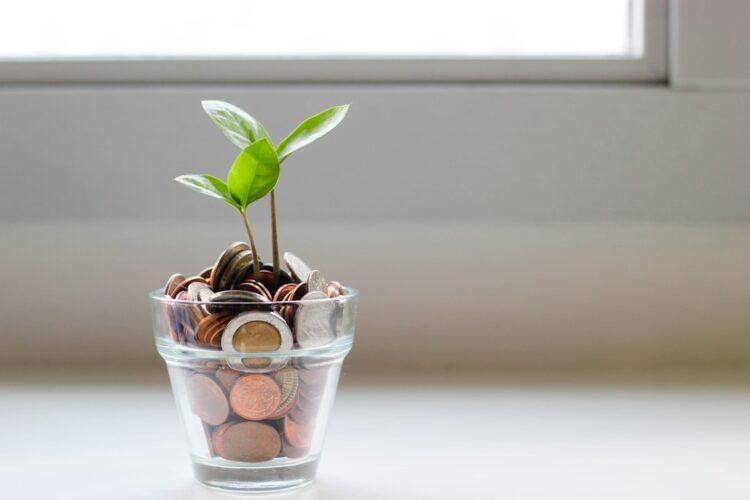
$200 a month turns into $298,000 over 30 years. Sounds like a scam, right? It’s not. It’s compound interest—the same math that makes credit card debt spiral out of control, except working in your favor. The catch? You need to actually start, park your money in the right accounts (not your Chase checking earning 0.01%), and leave it alone. This isn’t some get-rich-quick scheme for people with trust funds. It’s patient math that works for anyone willing to automate $50, $200, or $500 a month into a Fidelity IRA, Ally savings account, or Vanguard index fund. We’ll show you exactly how compound interest works, where to put your money to get it, and how much you’ll actually make with real numbers from real banks and brokerages.
What Compound Interest Actually Means (And Why Einstein Was Obsessed)
Your money makes money. Then that money makes money. That’s compound interest in one sentence.
Here’s what actually happens: You put $1,000 in a Vanguard mutual fund earning 5% annually. After year one, you’ve got $1,050. Simple enough. But in year two, you don’t just earn another $50. You earn 5% on the full $1,050, which gives you $52.50. Year three? You’re earning interest on $1,102.50, netting you $55.13.
Compare that to simple interest, where you’d earn exactly $50 every single year. After three years with simple interest, you’d have $1,150. With compound interest? You’ve got $1,157.63. That’s an extra $7.63 just from interest earning interest.
Seven bucks doesn’t sound life-changing. You’re right to think that. But scale this up to $200 a month for 30 years, and that “interest on interest” effect becomes the difference between having $72,000 (just your contributions) and $298,000.
Albert Einstein supposedly called compound interest “the eighth wonder of the world” and said “he who understands it, earns it; he who doesn’t, pays it.” Whether Einstein actually said this is debatable, but the wisdom holds. When you’re saving in a Schwab IRA or Fidelity 401(k), compound interest works for you. When you’re carrying a balance on a Chase or Capital One credit card at 24% APR, it works against you. Same math, opposite outcomes.
The real magic isn’t in the formula. It’s in time. Those first few years feel slow because you’re earning interest on small amounts. But give it a decade or two, and you’re earning hundreds of dollars per year on money you never actually deposited yourself.
The Rule of 72: Your Quick Money-Doubling Calculator
Want to know how long it’ll take to double your money without pulling out a calculator? Divide 72 by your interest rate. That’s it.
If you’re earning 6% annually, your money doubles in 12 years (72 ÷ 6 = 12). At 8%, you’re looking at 9 years. At 3%, you’re waiting 24 years. This trick works whether you’re calculating investment returns or figuring out how fast credit card debt can spiral.
Real Bank Rates Right Now
Here’s where the Rule of 72 gets brutally honest about where you park your cash:
- Chase savings account at 0.46%: Your money doubles in 156 years (good luck with that)
- Ally high-yield savings at 4.5%: Doubles in 16 years
- Stock market average at 7%: Doubles in roughly 10 years
- Credit card debt at 22%: Your balance doubles in just 3.3 years if you ignore it
What the Math Looks Like
Let’s say you stash $5,000 in different accounts. The Rule of 72 shows you exactly what you’re signing up for:
At 1% (typical big bank savings), you won’t hit $10,000 until 2096. Your great-grandkids might enjoy that.
At 5% (decent index fund or high-yield savings), you’re at $10,000 in 14.4 years. That’s actually within your lifetime.
At 10% (aggressive stock portfolio average), you double to $10,000 in 7.2 years. Do that three times and you’re at $40,000 in about 22 years.
The formula isn’t perfect—it’s slightly less accurate at extreme rates—but it’s close enough for quick decisions. When you’re comparing a Vanguard index fund charging 0.04% versus a mutual fund charging 1.5%, you can instantly see that higher fee means your money takes an extra 24 years to double. That’s the difference between retiring at 65 versus working until 89.
Where to Actually Get Compound Interest on Your Money
You can’t just wait for compound interest to find you. You need to park your money in the right accounts at the right institutions, and those choices depend entirely on when you’ll need that cash.
For Your Emergency Fund (Safety First)
Your emergency fund needs to stay liquid and safe, which means high-yield savings accounts. As of early 2025, Ally Bank pays around 4.00% APY on their savings account with no minimum balance. Marcus by Goldman Sachs offers similar rates, usually between 4.00% and 4.35% APY.
These aren’t going to make you rich, but here’s what matters: that money compounds daily and you can access it immediately when your car breaks down or your water heater floods the basement. A $10,000 emergency fund at 4.25% APY grows to $10,434 after one year without you lifting a finger.
The FDIC insures these accounts up to $250,000, so yes, it’s safe. Much safer than leaving $10,000 in your Chase checking account earning 0.01% (basically nothing).
For Long-Term Wealth Building
This is where compound interest actually gets exciting. The stock market has historically returned about 10% annually over long periods, and you can tap into that through index funds.
Open a Roth IRA or traditional IRA at Fidelity, Vanguard, or Schwab. You’ll want to invest in an S&P 500 index fund like Vanguard’s VOO or Fidelity’s FXAIX. These funds charge microscopic fees (0.03% to 0.05% annually) and own slices of 500 major US companies.
Here’s the comparison that matters:
| Account Type | Where to Open | Best For | Typical Return | Tax Treatment |
|---|---|---|---|---|
| High-Yield Savings | Ally, Marcus | Emergency fund, short-term goals | 4.00-4.35% | Taxable interest |
| Roth IRA | Fidelity, Vanguard, Schwab | Retirement (tax-free growth) | ~10% historical | Tax-free withdrawals |
| Traditional 401(k) | Your employer | Retirement (pre-tax savings) | ~10% historical | Taxed at withdrawal |
| Taxable Brokerage | Fidelity, Schwab, Robinhood | Long-term goals, after maxing retirement | ~10% historical | Capital gains tax |
Your 401(k) through work is non-negotiable if they offer a match. That’s free money that immediately compounds. If your employer matches 50% of your first 6%, you’re getting an instant 50% return before any market growth.
Dividend reinvestment plans (DRIPs) add another layer. When you own stocks or funds that pay dividends, you can automatically reinvest those payments to buy more shares. Schwab and Fidelity both offer free automatic dividend reinvestment. Those reinvested dividends buy more shares, which generate more dividends, which buy more shares. It’s compounding on top of compounding.
Why Starting 10 Years Earlier Doubles Your Retirement Money
That decade you’re thinking about waiting? It’ll cost you roughly $150,000.
Here’s the brutal math: If you invest $200 every month starting at age 25, assuming a 7% average annual return (the historical average for a diversified stock portfolio), you’ll have about $298,000 by age 65. Start at 35 instead? You’ll end up with around $148,000. Same monthly contribution, same return rate, but nearly half the money.
The difference isn’t just the extra $24,000 you put in during those 10 years. It’s what that money earns over the following three decades.
The Math on Starting Early
Let’s break down where that money actually comes from. When you start at 25, you contribute $96,000 total over 40 years ($200 × 12 months × 40 years). But you walk away with $298,000. That extra $202,000? Pure compound growth.
Start at 35, and you contribute $72,000 over 30 years. You end with $148,000, meaning $76,000 came from growth.
Notice something? The first 10 years of contributions ($24,000) generated $126,000 in additional wealth. Those early dollars have four full decades to compound, turning $200 into $1,500 or more. Your last 10 years of contributions? They barely have time to double.
This is why financial advisors get pushy about starting young. You don’t need to invest huge amounts in your twenties. You just need time. A 25-year-old investing $200/month will beat a 35-year-old investing $400/month—and the younger saver puts in $48,000 less of their own money.
What If You’re Already 35 or 45?
You’re not screwed. You just need to be more aggressive with your monthly contributions.
If you’re 35 and want that $298,000 by 65, you’ll need to invest about $400/month instead of $200. At 45? You’re looking at roughly $750/month to hit the same target. The numbers get steeper because you’ve lost the compounding runway.
But starting late beats never starting. A 45-year-old who invests $200/month will still have $61,000 by 65. That’s better than zero, and it’s money working for you instead of sitting in a checking account at Chase earning 0.01%.
Daily vs Monthly vs Annual Compounding: Does It Actually Matter?
You’ll see banks advertise “daily compounding!” like it’s some magical feature. The truth? It helps, but barely.
Here’s what happens when you park $10,000 in an account paying 5% APR for one year:
- Daily compounding: $10,512.67
- Monthly compounding: $10,511.62
- Annual compounding: $10,500.00
That’s a $12.67 difference between daily and annual. Not nothing, but not exactly life-changing either.
The math works like this: more frequent compounding means interest gets added to your balance faster, so you start earning interest on your interest sooner. Daily compounding divides that 5% into 365 tiny slices. Monthly splits it into 12 chunks. Annual gives you the whole thing once.
Where you’ll actually see these differences: High-yield savings accounts at Ally, Marcus, or Discover typically compound daily. That’s standard for savings accounts. Some bonds compound annually or semi-annually. CDs can go either way depending on the bank.
Should you obsess over compounding frequency when choosing where to put your money? No. A 4.5% rate compounding daily beats a 4.0% rate compounding monthly every single time. The rate itself matters way more than how often it compounds.
Focus your energy on finding the highest rate and keeping your money invested for as long as possible. Those two factors will dwarf any benefit from daily versus monthly compounding. Chase offering 0.01% with daily compounding still loses spectacularly to a 4.5% high-yield savings account at Schwab, even if Schwab only compounded monthly (which they don’t).
When Compound Interest Works AGAINST You
That same mathematical magic that builds wealth? It absolutely demolishes your finances when you’re carrying credit card debt.
Credit cards compound interest daily—not monthly, not yearly—at rates between 20% and 24% APR. That means every single day, your balance grows a tiny bit, and then tomorrow’s interest gets calculated on yesterday’s slightly higher balance. It’s the exact same exponential curve you saw in the investment examples, except now you’re on the wrong side of the equation.
The Real Cost of Carrying a Balance
Let’s say you’ve got a $5,000 balance on a Chase Freedom card at 22% APR. You decide to just pay the minimum—maybe $125 a month.
Here’s what actually happens: You’ll spend the next five years making payments. You’ll hand over $8,202 total. That’s $3,202 in pure interest—more than 64% of what you originally borrowed. The credit card company is earning compound interest on your money, and they’re thrilled about it.
If you only pay minimums, you’re essentially treading water while the current pulls you backward. Most of that minimum payment goes straight to interest, barely touching the principal balance. The compounding math keeps working its magic, just against you instead of for you.
This is why financial advisors hammer on paying off credit cards before investing. A guaranteed 22% return (which is what you get by eliminating that debt) beats any stock market average. You can’t out-invest credit card interest—the math simply doesn’t work.
Every dollar you pay in credit card interest is a dollar that could’ve been compounding in your favor for decades.
Your Action Plan: Start Compounding This Week
You’ve seen the math. Now here’s exactly what to do before Sunday night.
1. Open a high-yield savings account for your emergency fund
Head to Ally Bank or Marcus by Goldman Sachs right now. Both are paying 4.00%+ APY as of 2024, which is about 10 times what Chase or Bank of America savings accounts offer. The application takes 10 minutes. Move your emergency fund there—usually three to six months of expenses. Your money stays completely liquid while earning actual interest. Both banks are FDIC-insured up to $250,000, so yes, this is as safe as keeping cash under your mattress, except your money actually grows.
2. Check your employer’s 401(k) match immediately
Log into your HR portal or email your benefits person today. If your company matches 50% of the first 6% you contribute, that’s an instant 50% return before compound interest even starts. A $200 monthly contribution becomes $300 with the match. That’s free money you’re leaving on the table every single paycheck you wait.
3. Set up automatic transfers—start with whatever you can
Don’t wait until you “have more money.” Set up a $50 automatic transfer from checking to savings on payday. You can always increase it later. Schwab, Fidelity, and Vanguard all let you automate monthly investments with no minimum after your account is open.
4. Open a Roth IRA at Fidelity or Vanguard
This takes 15 minutes online. Put it in a target-date fund matching your retirement year—Fidelity Freedom 2060 Fund or Vanguard Target Retirement 2060, for example. Your money grows tax-free forever. You can contribute up to $7,000 per year in 2024.
What if you mess up? You can’t really. These accounts don’t lock your money away forever (emergency fund and Roth IRA contributions are accessible), and the worst case is you earn 4% instead of 0%.
Remember that $200 a month turning into $298,000? That’s not magic. It’s not gambling. It’s patient, boring math that rewards people who start and don’t touch it. Compound interest doesn’t care if you’re wealthy or just starting out—it only cares about time and consistency. The hard part isn’t understanding the formula or picking the perfect fund. It’s opening that account and setting up the automatic transfer. Every month you wait is compound growth you’ll never get back. Those dollars you invest today will work harder than any dollars you invest five years from now. So pick one thing from the action plan above and do it this week. Move your emergency fund to Ally. Bump your 401(k) contribution up by 1%. Open that Roth IRA you’ve been researching for six months. The difference between thinking about compound interest and actually using it is one 10-minute account application.


